Thursday, 31 October 2013

Bing on a bog!


The bing at Fallin is the unwanted spoil from the coal mining industry and this spoil actually lies on top of a peat bog! The bog Wester Moss is a Nature Reserve and a Site of Special Scientific Interest and is just to the south of Fallin Bing. The site is owned by Stirling Council and has been established as a partnership with Butterfly Conservation and the local community of Fallin. 

A volunteer with a leaf beetle on Wester Moss (c) Suzanne Bairner
Wester Moss is a lowland raised bog and these habitats are important for a wide range of wildlife species. Lowland raised bogs are a very scarce habitat and are typically found in the wetter parts of Britain within the north and west. Nearly 90% of their former area has been lost in Scotland.

Invertebrate species of conservation concern that have been recorded at Wester Moss include the Large heath butterfly (Coenonympha tullia) and the Bog sun-jumper spider (Heliophanus dampfi). 

Bog sun-jumper spider (Heliophanus dampfi) on Wester Moss (c) Lorne Gill
The Large heath is Britain’s only bog specialist butterfly and its caterpillars can even survive short periods underwater when its foodplant, Hare’s-tail Cottongrass (Eriophorum vaginatum) gets submerged.

The Bog sun-jumper is a tiny spider with distinctive fluorescent green legs and mouthparts. This species has only been recorded from a handful of other sites across Britain including Flanders Moss and Ochtertyre Moss that are both near Stirling.

Other wildlife and plants recorded at Wester Moss include Emperor moths (Saturnia pavonia), Hieroglyphic ladybird (Coccinella hieroglyphica), Common lizard (Zootoca vivipara), Round leaved sundew (Drosera rotundifolia) and the Nationally Scarce Bog-rosemary (Andromeda polifolia). 

The Hieroglyphic ladybird (Coccinella hierglyphica) (c) Steven Falks
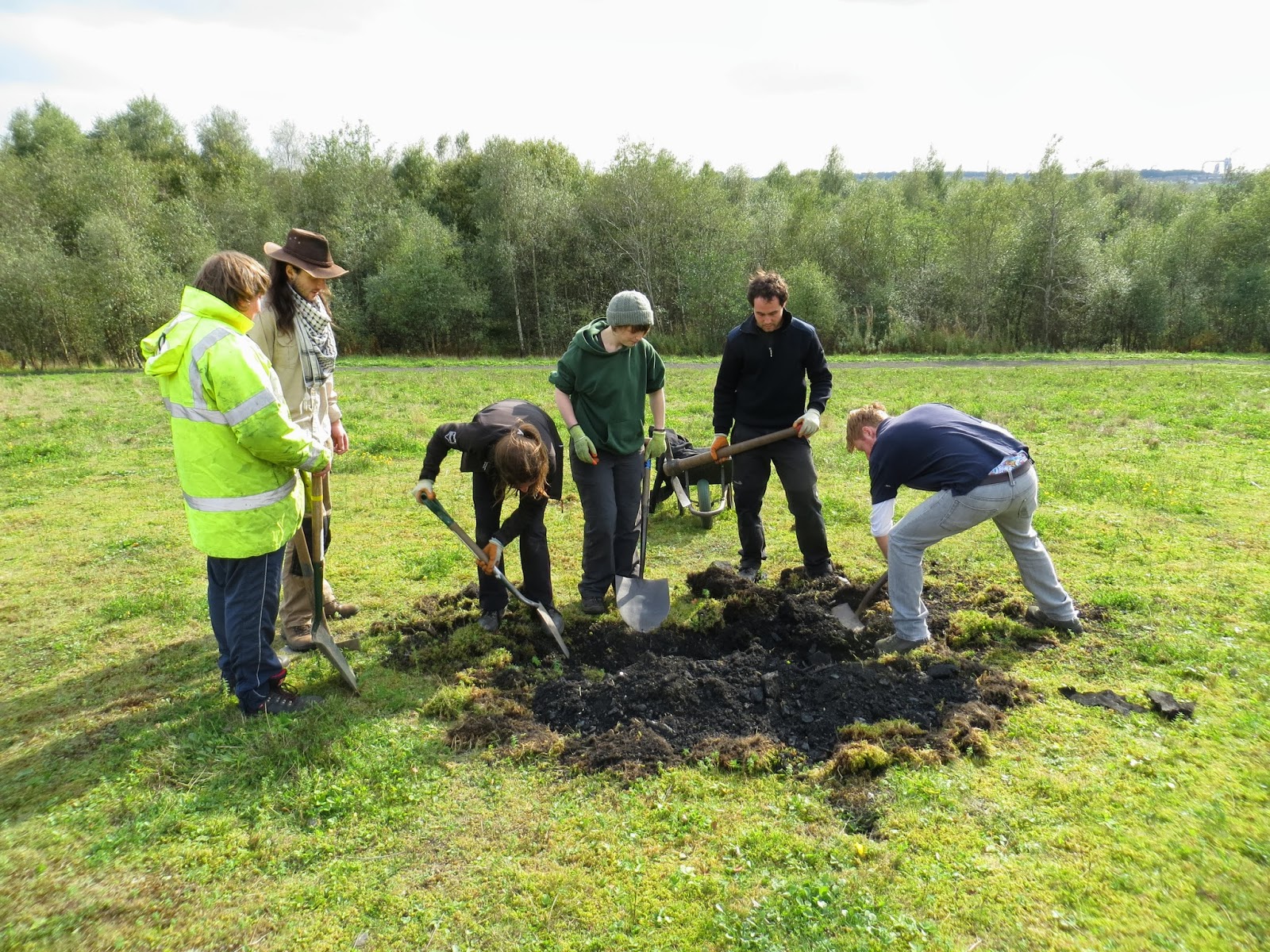
Butterfly Conservation and Stirling Council are working to restore the bog to its former glory and work to create more ditches and to remove birch scrub is on-going. There is a habitat creation day on Saturday the 9th of November (10am-3.30pm) and Wednesday the 13th of November (10am-3.30pm) that everyone is welcome to attend for as little or as long as they want. For more information about the day and to book a place contact Scott Mason (Apprentice Ranger, Land Services), Stirling Council, Allan Water House, Kerse Road, Stirling, FK7 7TE, Tel:  01786 237792, E-mail: masonsc@stirling.gov.uk

For further habitat creation days at Wester Moss check out Butterfly Conservations website: http://butterfly-conservation.org/842/scotland.html

Wednesday, 16 October 2013

Life underground and its difficulties!


Working in a coal mine was not an easy job for anyone. Before health and safety was improved during the 1940’s life underground was fraught with danger! One wrong move could lead to broken bones, loss of limbs or even death. In 1947, the coal pit at Polmaise was nationalised and safety was vastly improved but from when it opened in 1904 till then, 35 miners had lost there life and more than this were severely injured. 

File:Harry Fain, coal loader, places and secures safety timber close to the face where he will work. Inland Steel Co... - NARA - 541483.tif
A coal miner at work underground (Image taken from Wikimedia Commons).
Most of the accidents in the pit were because of underground explosions caused by sparks coming off boring hammers which ignited any gas in the surrounding air. Another main cause of accidents was due to rock fall and this was often due to the limited amount of tools the miners would have with them that consisted of a shovel and a pick. The most important thing when working in the pit was to get the supports up to prevent rock fall and potential accidents.

With the death of a miner, many families were left without the main breadwinner and the family would be left to endure many hardships. In a small village like Fallin, neighbours, relations and friends would band together and help the family. With the change in safety laws, this improved the lives of many families as well as the community of Fallin and other nearby coal mining villages such as Plean and Cowie.

File:Man of the Mine- Life at the Coal Face, Britain, 1942 D8251.jpg
Miners waiting to head home from the coal mine (Image taken from Wikimedia Commons).
Below are only a handful of fatal accidents that happened in the early years at Polmaise Colliery pits 3 and 4 at Fallin (taken from Scottish Mining Website http://scottishmining.co.uk/352.html):

12th February 1923- miner killed and another seriously injured at number 3 pit at Polmaise Colliery, Fallin when a large portion of the roof of one of the roads fell on them.

8th May 1923- body of a fireman from the mine was found in the morning in number 3 pit after he went to make an inspection of the pit. On failing to return a search party was sent to look for him and he was found dead.

2nd October 1925- fatal accident of a miner in number 3 pit when 2 tons of rock fell from the roof. The miner was pinned under the debris where he was found dead.

26th February 1926- large stone weighing 13 cwts fell and seriously injured a miner about the head and he was taken to Stirling Royal Infirmary where he later died of his injuries.

16th November 1928- Miner crushed by large stone at number 3 pit and was removed to Stirling Royal Infirmary where he died shortly after arrival. He was employed at Polmaise Colliery in Fallin for 21 years.

30th August 1931- Miner dies in Stirling Royal Infirmary of internal injuries from rock fall from the roof of the mine the previous week.

1st July 1934- Miner killed and several injured after an accident in the cages at number 3 pit after they overwound the cage. Seven men were descending the pit at the time and six were coming to the surface. The miners in the descending cage, which struck the pit bottom, were most seriously injured. The accident occurred when the afternoon shift was succeeding the day shift and miners going to their work helped carry the injured men from the pithead to the ambulance room. The joiner's shop was utilized for this purpose. The injured men were brought to the surface using number 4 shaft. Another miner later succumbed to his death.

Thursday, 3 October 2013

Creating banks for bees!

Our habitat creation day at Fallin Bing on Tuesday this week was a great success with 14 volunteers from The Conservation Volunteers and the Green Gym coming along to help clear birch scrub from along the pathways and also create 2 bee banks. We were lucky as the sun was out and the rain clouds held off!
Before the area was cleared of birch scrub....


....and after.
When we arrived at site we decided to focus on clearing the birch scrub. After lunch, when the Green Gym turned up we split the group into two. Part of the group carried on with clearing scrub and the rest went to create a couple of bee banks. The banks add a topographical interest to the relatively flat slopes of the bing. They will be perfect for warmth loving invertebrate species such as ground beetles and spiders and also butterflies that like these areas for basking.

Volunteers creating the bee bank.
There was lots of wildlife out and about including Pink footed geese flying overhead. Fungi were growing up everywhere including this beautiful purple mushroom seen in the photo below.

A beautiful purple mushroom at Fallin.
This is the last of the habitat creation days this year but we will be back at Fallin next year to run some more bug walks as well as other activities- so look out for more information on the blog.

Thursday, 26 September 2013

Join in and get outside for fun on the Bing!

On Tuesday the 1st of October we are having another habitat creation day at Fallin Bing. We will be there from 10am- 3pm and anyone and everyone is welcome to come along for as little or as long as they want! We will be clearing encroaching birch scrub from along the paths and maybe creating some bee banks along the sides of the Bing. The bee banks will add some variety in height along the Bing which has fairly flat sloping sides. This will benefit ground loving invertebrates that love to bask in areas of bare ground.


TCV learning about the history of Fallin Bing
I shall be bringing cake and biscuits along for the day and also some refreshments. Volunteers from The Conservation Volunteers and TCV Green Gym will be there to help out. I will be out and about with the video camera getting footage of volunteers hard at work and also having fun.

If interested in coming along or for more information about the project please contact Suzanne Bairner at Suzanne.bairner@buglife.org.uk and 01786 447504.

Thursday, 19 September 2013

Buglife staff have fun on the bing!

Buglife have just had their annual staff conference and this year we were in Scotland! We decided to take the team to Fallin Bing to show them the work we have been doing and also how amazing the site is. Although cold at the top of the bing with the wind, the sun was shining allowing us to see the views from the top.
 

Buglife staff enjoy the view from the top of Fallin Bing
Buglife staff were given nets to have a look for some bugs and managed to collect some different things to what Niall Currie (TCV Natural Talent Apprentice who has been surveying Fallin for invertebrates-see blog post from 27th August and 12th September) had collected before. We had a caterpillar of the Birch sawfly (Cimbex femoratus) and the Peppered moth (Biston betularia) as well as the hoverfly Sphaeroprhoria scripta.
Looking at the sweep net to see whats inside...
As the sun was out there were lots of bugs around.
While they were busy collecting and having fun I was out with the video camera getting some footage of the team at work. It was great to get footage of the Buglife staff collecting bugs as well as lots of photos as we can use this for the digital record for the All Our Stories project which we will give back to the local community to use.
We have our next habitat creation day on Tuesday the 1st of October from 10am to 3pm. We will be clearing birch scrub from the footpath and also creating some banks for ground nesting invertebrates. Everyone is welcome to attend and cake will be provided! You can come along for as little or as long as you want. We will be meeting in the car park at Fallin Mining museum at 10am. For more information about the day please contact Suzanne Bairner at suzanne.bairner@buglife.org.uk and 01786 447504.

Thursday, 12 September 2013

The amazing bugs of Fallin Bing!

As mentioned in the previous post I have been surveying Fallin Bing for its invertebrates and have so far recorded many interesting finds.

At this time of year there are many hoverflies going about.  They are often yellow and black, looking a bit like bees and wasps, but like all true flies they only have one set of wings and don’t have long antennae.  One of the most common and distinctive is the Marmalade hoverfly (Episyrphus balteatus), many of which actually arrive on British shores after an incredible migration through Europe.  Hoverflies mostly feed on nectar from flowers and are important as pollinators of plants.
Another colourful nectar feeder is the Small copper (Lycaena phleas) butterfly.  I’ve been seeing them since the start of August as the second generation of these attractive little butterflies have taken to the air.  However by the end of their flight period the males can look very battered as the will vigorously defend their patch.
A Small copper butterfly resting within the meadow at Fallin Bing
Among the most familiar of the flying insects are the bumblebees and Fallin bing is rich with them because of all the flowers they can gather pollen from.  On one visit to the Bing I watched a huge Buff-tailed bumblebee queen feeding on the bright yellow Common bird’s-foot trefoil (Lotus corniculatus) flowers.  This species has a short tongue and they struggle to reach the nectar within deeper flowers.  So instead of sticking her head into the flower tube I watched her being a bumblebee burglar and biting her way through the side of the petal to steal the nectar without helping to pollinate the flower!
Down on the ground layer there are many other bugs to be found.  I have focussed my surveys on the predatory Ground beetles and Spiders, which are very numerous all across the Bing.  The wolf spiders are so called because people used to think they hunted in packs.  In fact they are solitary hunters, but in warm sunny patches dozens can sometimes be seen scampering about.  At this time of year it is also worth looking out for females with egg sacs attached to the end of their bodies.
Another interesting group are the Jumping spiders (Family Salticidae), this time the name is more apt, since they do actually leap on their prey.  They have a row of large eyes, which gives them the best vision among the spiders, allowing them to identify prey and judge distance before jumping.  Yesterday, I was trying to identify a tiny jumping spider I had found on the Bing and to my astonishment I found it was half male and half female.  With one of the boxing glove-like appendages of a male and the other more slender like the female.  It also had one front leg with special marking that the males use to wave to females and the other was patterned as is usual for females.  This hermaphroditic form is very unusual in spiders with an estimated 1 in 17 000 showing this trait!
A jumping spider (c) Roger Key
Harvestmen are the odd looking relatives of spiders, with very long comical looking legs.  Unlike spiders they do not have a narrow waist between their two body parts and do not produce venom.  They do however also eat small insects or decaying items.  A favourite of mine is the Horn-palped harvestman (Phalangium opilio) whose male is very distinctive with horn like front limbs.  These creatures actually peak in numbers in autumn and were regularly seen during harvest time, which is where the name comes from.
Over the last few months I have been amazed by the diversity of life on Fallin Bing and I have found there is always something new and interesting to be discovered.  Why not go to Fallin Bing for a mini safari and take a look for yourself?
Niall Currie
TCV Natural Talent Apprentice

Tuesday, 27 August 2013

Surveying for bugs at Fallin Bing!

If you have taken a walk on Fallin Bing in the last few months you may have seen someone armed with a net running around chasing after insects.  Well that person was me!  I am Niall Currie a TCV Natural Talent Apprentice with Buglife.  I have been carrying out invertebrate surveys on brownfield sites around Stirling and Alloa including Fallin Bing.  When I first saw the Bing last winter it was hard to believe that it would become the colourful, flower rich place that photos of the previous summer suggested.  Although spring remained cold for longer than expected, the transition from a bare and dead landscape to one flourishing with wildflowers and buzzing with insects has certainly taken place. 


Niall surveying the bing for invertebrates

Insects are very useful creatures to survey because as well as being fascinating in their own right they are very sensitive to environmental conditions and can tell you a lot about a place.  The information I collect from these surveys will be used to decide how the site should be managed in the future. 

A Common carder bee feeding on a Red clover at Fallin Bing
Fallin Bing is a great haven for wildlife, especially invertebrates because it has a mixture of different types of vegetation as well as some nice bare patches, which help cold-blooded invertebrates warm up.  The south side of the slope is especially good for this.  There is also a diversity of wildflowers at the Bing which provide many bugs with food and homes or places to hunt.  Invertebrates have so many different ways of life so to survey a good range I have had to employ lots of different methods to find them.  This has included crawling around searching for them by hand to sweeping the vegetation with a thick net and using a thin meshed net to catch flying insects.

Read more next week about some of the interesting bugs I have found!